Monthly Archives: December 2011

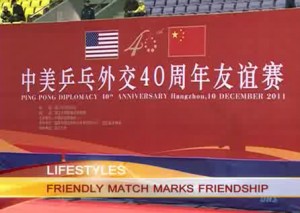
40th Anniversary of Ping Pong Diplomacy: Zhejiang University in Hangzhou

Ping Pong Diplomacy in HangzhouThis video is a CNC television report from Hangzhou about an event at Zhejiang University celebrating the 40th Anniversary of Ping Pong Diplomacy. Judy Hoarfrost of Paddle Palace, an original Ping Pong Diplomacy Team member, traveled with the delegation.

Table Tennis Tip: Balance is a Habit

Recently I had an epiphany. It wasn’t anything that wasn’t obvious, but it was something that underlined a primary difference between hackers and pros – or more generally, between lower-level and higher-level players. And that is the habit of balance.

While practicing with a student, I hit a net ball to the right-handed student’s forehand side. The student immediately reached for the ball. This put his weight on his right foot. Since he could no longer step with that foot (try it, you’ll see), he was forced to lunge for the ball. He managed to reach it and popped it back on the table, an easy winner for any decent opponent.

Table Tennis Training Stage IV: Putting It All Together

In stage four, I’m planning not to make any major changes to my strokes. It takes about thirty days to permanently change a stroke. If I choose to make a change, my game will progress downward a bit, and I don’t have time for that. By the Olympic trials, my strokes should be completely automatic with no thought about the actual mechanics of the stroke.

Table Tennis Tip: Time-Out Tactics

Each player is allowed a one-minute time-out during a match. (Often a coach calls the time-out, but the player can waive that off if he doesn’t want one at that time, except in a team match.) When should you call a time-out? Here are some scenarios where you should call a time-out – but remember, you are only allowed one, so choose carefully. I’ve put them in order of priority

Blake Griffin, professional ping pong player?

Blake GriffinBlake Griffin, pro basketball player, tries his hand at table tennis. His opponent: Soo Yeon Lee, pro ping pong player and professional model. While the players were away from the court, many of them had to find new ways to fill their time. Blake Griffin was no exception to this. Fortunately for Griffin, the lockout is over.

Table Tennis Tip: Depth Control of Serves

By Larry Hodges. One of the most under-practiced aspects of serving is depth control. Most intermediate and advanced players know that serving short stops an opponent from looping. As players advance, they begin to see the advantage of serving short with the second bounce as deep as possible. This makes it harder for the opponent to flip or drop short, to return at a wide angle, or rush the server.

As they advance, players also begin to see that a deep serve that goes very deep, so the first bounce is near the opponent’s endline, is much more effective than a long serve that bounces more in the middle of the table. The deeper the bounce, the more you jam the receiver, force him off the table, cut off angles, and give yourself more time to react to his shot. (Deep serves can either be spin serves, fast serves, or a combination of both.)

Table Tennis Tip: Push with Purpose and Placement

By Larry Hodges. So often players push just to keep the ball in play. Push with purpose and placement! Always do something with the push. So, what can you do?

Purpose: There are three basic things you can do with the push.

Table Tennis Tip: Going to the Well Too Often

By Larry Hodges. If you find a tactic that really gives your opponent trouble, do some serious thinking about how often to use it. You may have two options: 1) use the tactic to win one game; or 2) use the tactic to win the match. If you want to squeeze an entire match out of the winning tactic, then you don’t want to overuse it and allow the opponent to get used to it.

Why Is Your Grip Pressure So Important?

By Massimo Constantini. There is one aspect of the grip that is very important but does not get enough attention. This is the amount of pressure each player applies to his or her handle when holding the paddle. How tight or lose a player’s grip impacts the result of their shot!

Maximizing Your Table Tennis Game Under Poor Circumstances

True or False Question: One must play against better players in order to improve?
Answer: FALSE
It is possible to improve your table tennis game even if you don’t have ideal training partners. In this article I suggest TEN ways that you can maximize your table tennis game under poor training circumstances.